Dermal fillers do not have one fixed expiry date. How long a result remains visible depends on the filler material, treatment area, product formulation, amount injected, placement and individual response.
Hyaluronic acid (HA) fillers are temporary, but the visible result does not always disappear at the same time as the filler material itself. Research using ultrasound and MRI suggests that residual HA can sometimes remain detectable after the cosmetic effect has reduced.
This means how long your filler looks effective and how long some filler remains within the tissue are not necessarily the same thing.
Dermal filler longevity can refer to the visible result, how long some filler remains within the tissue, or when another treatment may be appropriate. These timelines do not always match.
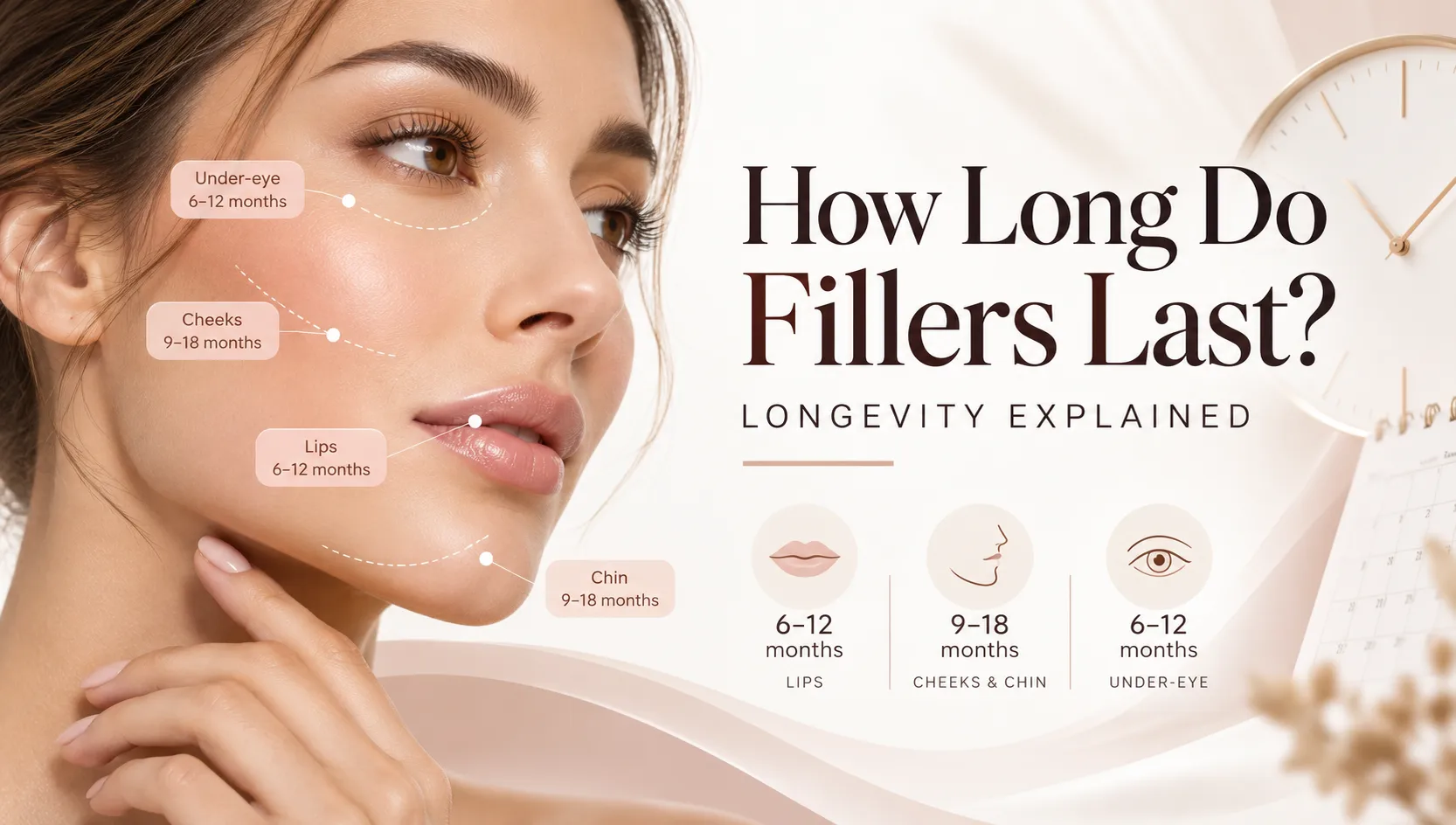
The FDA’s guidance on dermal fillers describes HA filler effects as lasting approximately 6–12 months as a broad material category. Some individual HA products and treatment areas may provide visible correction beyond this range, while others may soften sooner.
The visible result refers to how long the intended volume, contour or definition remains noticeable. Filler persistence refers to how long some injected material may remain within the tissue. The treatment interval is the point at which further filler may actually be appropriate.
For example, a cheek may look closer to its original shape while some HA is still present. Equally, reaching month six or twelve does not confirm that the treatment area has completely returned to baseline.
For this reason, filler duration is better understood as a range rather than an expiry date.
The material itself influences longevity.
| Filler material | General longevity context |
|---|---|
| Hyaluronic acid (HA) | Approximately 6–12 months as a broad FDA category, although some products and areas can last longer |
| Calcium hydroxylapatite (CaHA) | Effects may last approximately 18 months |
| Poly-L-lactic acid (PLLA) | Results develop gradually and may last around 2 years |
| PMMA | Non-absorbable filler material designed to remain in the body |
These materials are not interchangeable. A longer-lasting filler is not automatically more appropriate. The product also needs to suit the treatment area, tissue behavior and result we are trying to achieve.
No. The treatment area can significantly affect how long the visible result remains.
The lips are highly mobile because they move while speaking, eating, smiling and making facial expressions. Lip filler therefore often sits toward the shorter end of HA longevity expectations.
The cheeks and mid-face are commonly treated at deeper structural levels and move less than the lips. Depending on the product and treatment goal, visible correction may remain noticeable for longer.
The chin and jawline may also involve deeper structural placement and products chosen to create projection or definition, so their longevity can differ from softer filler used in more mobile tissue.
The under-eye area is another example where simple expiry estimates can be misleading. Small amounts of HA may sometimes remain detectable considerably longer than the visible result suggests.
Treatment-area ranges can therefore help with expectations, but they should not be treated as countdown timers.
Filler longevity is influenced by several factors acting together rather than one single characteristic.
Product formulation: HA fillers differ in properties such as cross-linking, firmness and tissue behavior. These differences affect how the product performs and gradually changes within the tissue.
Treatment area and placement: A highly mobile area behaves differently from a deeper structural area. Injection depth and anatomical placement can also influence how the result changes over time.
Amount injected: The amount of filler can affect how long a visible correction remains, but injecting more simply to make a treatment last longer is not an appropriate strategy.
Previous filler: Residual product from earlier treatments may still be present when another treatment is considered. This can make later results appear to last differently from the first.
Individual response: No two patients process filler in exactly the same way, so the same product placed in the same area may not produce identical longevity in two people.
Patients also sometimes assume that frequent exercise or having a “fast metabolism” means their filler will disappear much sooner. Individual biology may play a role, but we cannot accurately calculate filler longevity from exercise habits alone.
The same applies to living in Dubai. The climate itself does not give us a reliable way to predict when injected filler will disappear. Treatment decisions should be based on the actual result rather than assumptions about heat, exercise or lifestyle alone.
Yes. A filler result can become less noticeable before all detectable product has disappeared.
Objective evidence of HA persistence beyond 12 months was identified in multiple studies in a systematic review of 24 studies with 1410 patients. Three-dimensional evaluations revealed detectable HA at 12 and 24 months and ultrasound showed detectable persistence at 12 to 36 months.
A separate MRI study examined 33 patients who had previously received HA filler in the mid-face. Residual HA was identified at least two years after treatment, including in patients who had not received further mid-face filler for more than five years.
These findings do not mean every dermal filler remains visibly effective for several years. They show that visible correction and detectable filler are not necessarily the same thing.
A small amount of residual filler may remain without producing enough volume or projection to be obvious. At the same time, the surrounding face continues to change with age, so the relationship between the filler and nearby tissues also changes.
This is why looking closer to your pre-treatment appearance does not necessarily prove that no filler remains.
A top-up should be based on the current result rather than a fixed six- or twelve-month schedule.
Before adding further filler, we consider how much of the original correction remains, whether previous filler may still be present, how the treated area currently looks and whether additional volume would genuinely improve the result.
Repeated treatments can also make later results appear to last longer. If some previous product remains when new filler is added, the starting point is different from the first treatment.
This can explain why someone may feel: “My second filler treatment lasted much longer than my first.” That does not necessarily mean the new filler itself has become more durable. Some of the previous filler may still have been contributing to the result.
One patient may benefit from a small additional treatment after a year, while another treated at the same time may still have enough volume and need nothing. The treatment date alone cannot make that decision.
No. Longevity is only one characteristic of a filler, and a result lasting longer than expected does not automatically mean something is wrong. The filler also needs to suit the treatment area, tissue movement, required softness or structural support and desired result.
For example, lips need to move naturally, while deeper cheek or chin treatment may require different product characteristics. Selecting a filler simply because it has the longest expected duration can therefore be the wrong approach.
Current imaging evidence also shows that HA can sometimes remain detectable longer than older longevity estimates suggested. This makes previous treatment history important even when filler was injected several years ago.
Tell your clinician about previous filler, particularly if:
Assessment is also appropriate if an area becomes newly swollen, uneven, uncomfortable or changes after previously being stable.
No. Filler persistence and filler migration are different.
Persistence describes how long filler remains present within the tissue. Migration describes filler moving beyond the area where it was intended to remain. A filler can remain detectable for a long time without migrating.
If your concern is specifically filler appearing outside the intended lip area, our Lip Filler Migration & Dissolving guide explains this separately.
At Maris Clinic, we do not treat dermal filler as something that automatically needs replacing after a set number of months. When you return for a review, we look at how the original result has changed and whether any further treatment is actually needed.
Your previous filler history is particularly important. We consider which areas have been treated, when they were treated and, where known, which products and amounts were used. This helps us understand whether a change in appearance reflects reduced correction, residual filler or simply changes in the surrounding facial tissues over time.
If you are considering Dermal Fillers in Dubai, your treatment plan is therefore based on your current facial proportions and goals rather than repeating a previous amount by default. Some patients may benefit from a conservative top-up, while others may be better advised to leave the area untreated for longer.
For us, filler maintenance is not about keeping to a fixed schedule. It is about preserving a balanced result while avoiding treatment that is not yet necessary.
Dermal fillers do not have one universal lifespan. The visible result depends on the filler material, treatment area, placement, amount and individual response.
HA filler is temporary, but imaging research shows that residual HA can sometimes remain detectable beyond the period in which the cosmetic effect remains obvious.
Further treatment should be based on what remains and what your face currently needs rather than automatically repeating filler after six or twelve months.
Book a personalized consultation with our medical team and discover the treatments tailored to your skin and lifestyle.