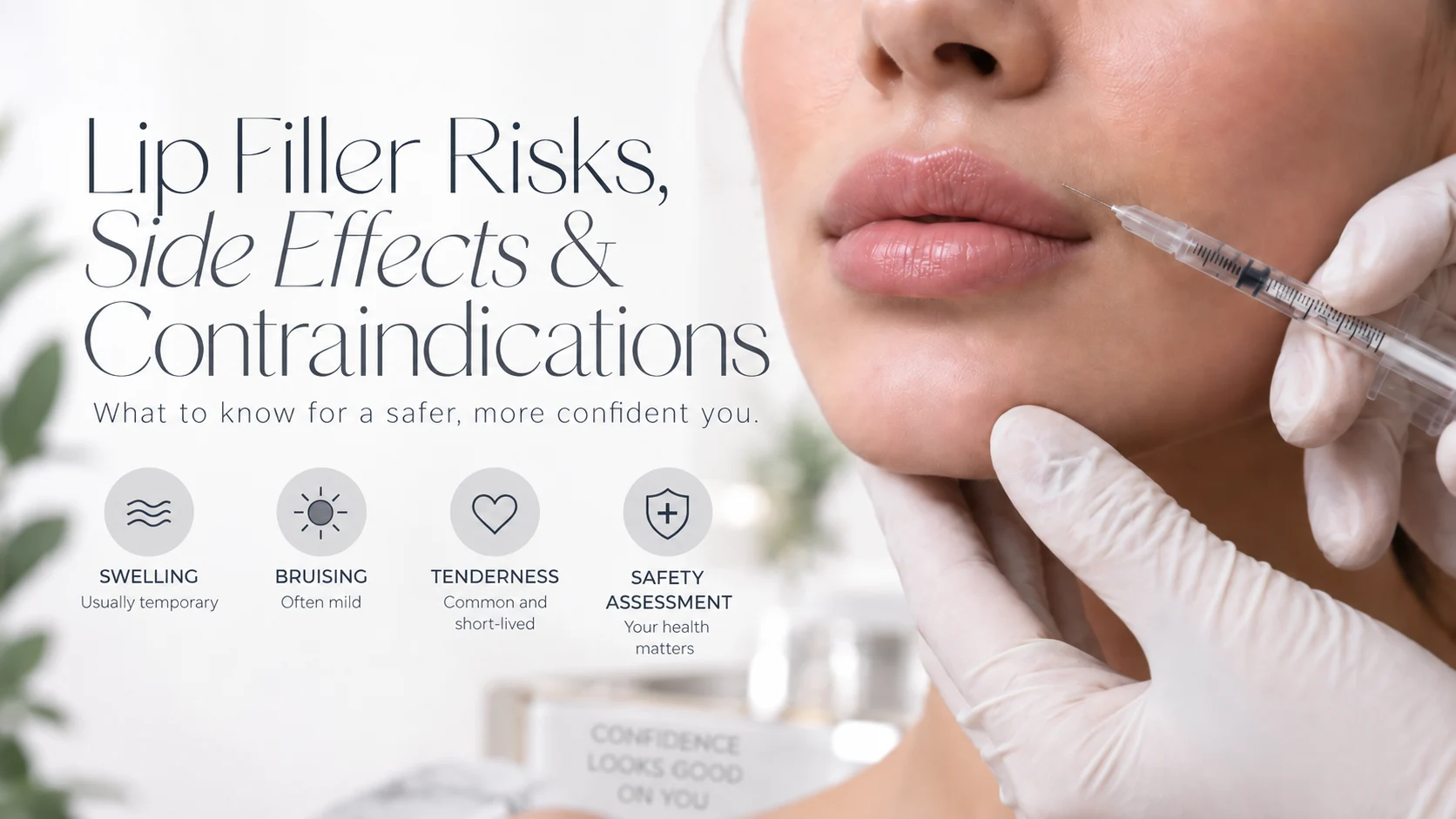
If you are considering lip fillers, it is important to understand what can happen after treatment as well as the results you hope to achieve.
Swelling, tenderness, firmness and bruising are common temporary reactions after hyaluronic acid lip filler injections. Serious complications are much less common, but they can occur and some require prompt medical attention.
A systematic review and meta-analysis by Wen et al., published in the May 2026 issue of Aesthetic Surgery Journal, analyzed 16 randomized controlled trials and found swelling in 78% of participants, firmness in 48%, bruising in 34% and tenderness in 33%.
The important distinction is knowing what is expected, what needs medical assessment and which warning signs require urgent attention.
Swelling, bruising, tenderness, redness and temporary firmness are common after lip filler injections. These reactions usually develop around the injection sites as the lip tissue responds to the injections and filler placement.
Common temporary side effects include:
Your lips can also appear slightly asymmetric during the first few days because each side may swell differently.
Cleveland Clinic lists bleeding, pain, tenderness, discoloration and swelling among recognized reactions to lip filler injections. It notes that swelling commonly improves within 24 to 48 hours, although it can take up to a week to settle.
These early changes are different from symptoms that become increasingly painful, inflamed or discolored instead of gradually improving.
Mild swelling, bruising and tenderness are expected. Increasing pain, unusual skin color, worsening inflammation or visual symptoms are not normal recovery signs.
A useful way to understand the difference is:
| Expected after treatment | Needs medical assessment | Needs urgent attention |
|---|---|---|
| Mild to moderate swelling | Swelling that keeps worsening | Severe or unusual pain |
| Mild tenderness | Increasing redness or warmth | Pale, gray, blue or mottled skin |
| Bruising | Persistent or painful lumps | Sudden visual changes |
| Temporary firmness | Discharge from an injection site | Blistering or tissue changes |
| Mild redness | Delayed swelling or nodules | Severe facial or tongue swelling |
| Temporary unevenness | Persistent asymmetry | Difficulty breathing |
The direction your symptoms are moving in matters. Swelling that gradually settles is different from swelling accompanied by increasing pain, heat, redness or discharge.
The FDA advises seeking immediate medical attention for unusual pain, vision changes or white, grey or blue skin near a dermal filler injection site.
Possible lip filler complications include infection, persistent lumps, inflammatory reactions, migration, persistent asymmetry and rare vascular complications. These complications need to be distinguished from temporary swelling, bruising and tenderness.
Yes. Infection can occur following dermal filler injections.
Some redness immediately after an injection can be expected. Redness becomes more concerning when it increases rather than improves, particularly when accompanied by:
The FDA lists infection, open or draining wounds and sores at the injection site among recognized dermal filler complications.
Persistent or worsening symptoms should therefore be assessed rather than assumed to be part of normal recovery.
Some temporary firmness can occur as swelling settles, but persistent, painful or delayed lumps need separate assessment.
Not every lump after filler represents the same problem. There is a difference between:
The FDA identifies nodules, granulomas and permanent hard nodules among possible dermal filler complications.
A lump that appears weeks or months after treatment should therefore not automatically be treated as ordinary post-injection swelling.
Filler migration occurs when filler material moves away from the intended injection area. This can create fullness or irregularity beyond the area originally treated.
Migration is different from temporary swelling. Swelling reflects the tissue’s response to an injection, while migration concerns the location of the filler material itself. The FDA recognizes filler migration as a possible complication.
Persistent asymmetry can occur, although unevenness during the first few days is often caused by swelling.
One side of your lips may swell more than the other after treatment. The appearance immediately after injections does not therefore necessarily represent how your lips will look once swelling has settled.
Asymmetry that remains after the expected swelling period needs to be considered separately from temporary post-treatment unevenness.
Allergic or hypersensitivity reactions to dermal filler products can occur.
The risk can depend on the specific filler and its ingredients. Some formulations, for example, contain local anesthetic such as lidocaine.
The FDA advises patients to disclose severe allergies, previous anaphylaxis and known allergies to relevant filler ingredients before treatment.
This is one reason the exact filler product and your medical history need to be considered together rather than assuming every filler has the same contraindications.
Vascular occlusion occurs when filler blocks or compromises blood flow through a blood vessel. It is rare but requires rapid medical attention.
Your lips and surrounding facial tissues depend on blood vessels to deliver oxygen. If filler enters a vessel or interferes with its blood supply, the affected tissue can become deprived of oxygen.
The relationship is:
Restricted blood flow → reduced oxygen supply → tissue injury → possible tissue necrosis
Possible warning signs include unusual or disproportionate pain and abnormal changes in skin color.
The FDA describes accidental injection into a blood vessel as the most concerning dermal filler risk. It can result in blocked blood supply and, in rare cases, tissue necrosis, visual abnormalities including blindness, or stroke. Vascular occlusion is therefore very different from ordinary bruising and should not be left to see whether it improves on its own.
Visual complications are rare, but a sudden change in vision after dermal filler injection is a medical emergency.
Blood vessels in different areas of the face form an interconnected vascular network. Accidental intravascular filler injection can, in rare circumstances, affect circulation associated with the eye.
The FDA recognizes visual abnormalities, including blindness, among rare serious consequences of accidental injection into a blood vessel.
Sudden blurred vision, loss of vision or another unexpected visual change during or after filler treatment requires immediate emergency medical attention.
Yes. Some filler complications develop after the initial swelling and bruising have already resolved. Complications can therefore be considered as early or delayed.
Early reactions and complications can include:
Delayed complications can include:
Cleveland Clinic similarly distinguishes early complications such as injection-site reactions, infection, allergy and vascular occlusion from later problems including granulomas, migration and late-onset infection.
The FDA also notes that some dermal filler side effects have appeared weeks, months or even years after injection.
A new lump, swelling or inflammatory change therefore deserves assessment even when your initial recovery was uncomplicated.
Lip filler injections can reactivate cold sores in people with a history of herpes simplex virus. The physical trauma caused by injections around the lips can trigger another outbreak in susceptible patients.
An active cold sore is also relevant before treatment. A review published in the Journal of Dermatology & Dermatologic Surgery identifies herpes simplex reactivation as a complication associated with lip augmentation and states that patients with active herpes simplex lesions should postpone filler treatment.
Tell the doctor assessing you if you currently have a cold sore or regularly experience outbreaks so this can be considered before injections take place.
Some circumstances mean lip filler treatment should be postponed, while others require individual medical assessment or may contraindicate a specific filler product.
Treatment should be delayed when there is active infection or inflammation around the area being treated.
Some examples include:
The FDA advises delaying dermal filler treatment when there is an active inflammatory condition or infection until it has been managed.
Contraindications depend partly on the specific filler product and its ingredients. Relevant factors can include severe allergies or known hypersensitivity to components within a particular formulation.
For example, the FDA advises patients to disclose allergies to lidocaine where a filler contains local anesthetic, as well as allergies to other relevant components used in particular filler products.
This is why contraindications should be checked against the product being considered rather than assuming all hyaluronic acid fillers have identical restrictions.
Your medical history can affect whether filler treatment is appropriate or whether additional assessment is needed.
Tell the doctor assessing you about:
Having one of these factors does not necessarily mean you can never have lip fillers. It means your individual circumstances need to be assessed before treatment.
The safety of dermal fillers during pregnancy and breastfeeding has not been established.
This distinction matters. Lack of safety evidence does not mean fillers have been proven to cause pregnancy complications. It means there is insufficient evidence to establish their safety for an elective cosmetic procedure.
The FDA states that dermal filler safety is unknown during pregnancy and breastfeeding. Pregnancy and breastfeeding should therefore always be disclosed during your consultation and medical assessment.
Some medicines and supplements can affect bleeding or bruising around injection sites.
Your doctor needs an accurate list of prescription medicines, over-the-counter medicines and supplements you take so any relevant risks can be considered before treatment.
The FDA specifically advises patients with bleeding disorders to alert their healthcare provider before undergoing dermal filler injections.
Do not stop prescribed medication yourself because you are planning lip filler treatment. Any change to medication should be discussed with the healthcare professional responsible for prescribing it.
Severe pain, abnormal skin color and sudden visual symptoms require urgent medical attention after dermal filler treatment. Seek urgent help if you develop:
Increasing redness, warmth, discharge or persistent painful swelling also needs medical assessment, even when emergency symptoms are absent.
The purpose is not to make ordinary swelling or bruising alarming. It is to recognise when your symptoms fall outside the expected response to injections.
Dubai regulates cosmetic filler injections as medical procedures, with specific requirements for patient assessment, consent and who can administer treatment.
The Dubai Health Authority’s Standards for Non-Surgical Cosmetic Procedures, Version 2.1 became effective on 18 February 2025. The standards classify cosmetic fillers as prescription-only and state that they may only be administered by a trained and privileged licensed physician.
DHA also requires a face-to-face consultation and assessment before a non-surgical cosmetic procedure. Written informed consent must be obtained, and patients must receive clear information about the procedure, risks, possible complications and outcomes.
Patient-selection criteria must consider factors including age, general health and whether the procedure is appropriate. Cosmetic fillers are not permitted for patients under 18 in Dubai, and the healthcare professional providing the procedure should also be available for follow-up care.
At Maris Clinic, lip filler treatment takes place within our regulated medical setting. Maris Clinic has been DHA-approved since 2017, and our medical team assesses your health history, allergies, medication, previous filler treatments and relevant contraindications before deciding whether treatment is appropriate.
This assessment matters because lip filler safety starts before the injection itself. Identifying an active infection, allergy, medication concern or another risk factor beforehand can prevent avoidable complications.
Appropriate medical assessment, qualified injection practice and early recognition of complications help reduce avoidable lip filler risks.
Important safety factors include:
No injectable treatment is completely risk-free. A safer approach is therefore based on appropriate patient selection, qualified medical treatment and the ability to recognise and respond to complications.
Previous filler treatment should be discussed before another injection. Your doctor needs to know what was injected, where it was placed and whether you experienced any previous reactions or complications before assessing further treatment.
The FDA also notes that the safety of repeated dermal filler use over long periods has not been evaluated in controlled clinical studies.
No. Individual filler products can have different ingredients, indications and contraindications. Your medical history needs to be considered alongside the specific product being proposed rather than treating every hyaluronic acid filler as identical.
Medication that affects clotting can be relevant to bleeding and bruising risk, but prescribed medication should never be stopped without medical advice. Tell the doctor assessing you what you take so your individual risk can be reviewed before treatment.
No. DHA standards state that cosmetic fillers are not permitted for patients under 18 years old in Dubai.
Most lip filler side effects are temporary, but complications can occur. Understanding what is expected, what needs assessment and which symptoms require urgent attention helps you make a safer, more informed decision.
If you are considering lip fillers in Dubai, schedule a consultation with our medical team to discuss your suitability, expected results and any safety concerns before treatment.
Book a personalized consultation with our medical team and discover the treatments tailored to your skin and lifestyle.