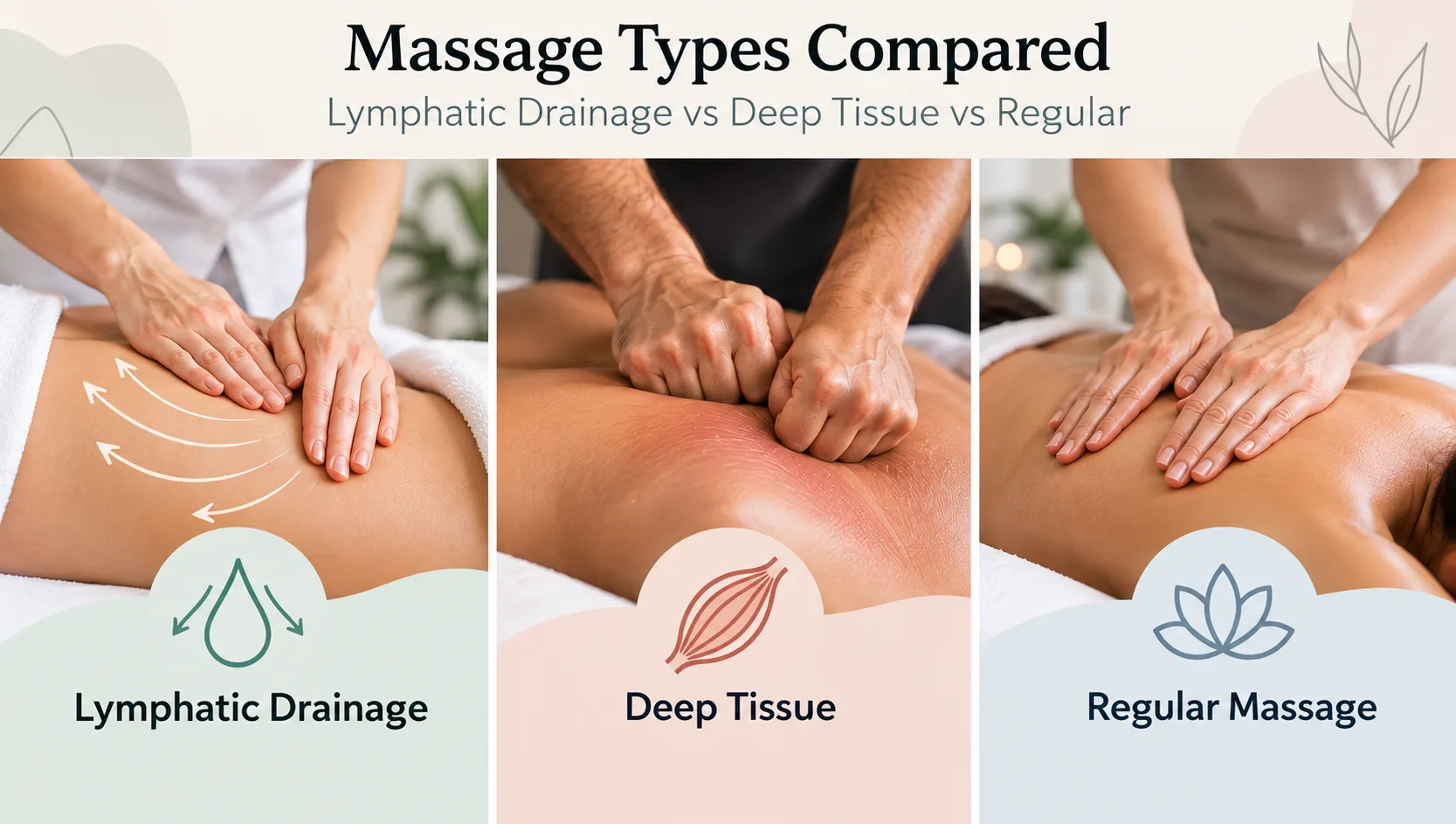
Lymphatic drainage, deep tissue massage and regular massage use different techniques because they address different concerns.
Lymphatic drainage uses light, rhythmic movements to encourage lymph fluid movement. Deep tissue massage uses firmer, focused techniques to work on deeper muscles and connective tissues. Regular or Swedish-style massage uses broader strokes and kneading mainly for relaxation and everyday muscle tension.
The right choice depends on what you want the treatment to address, not simply whether you prefer light or firm pressure.
The main difference is the system or tissue each massage is designed to work on.
| Feature / Aspect | Lymphatic Drainage (MLD) | Deep Tissue Massage | Regular / Swedish Massage |
|---|---|---|---|
| Main Focus | Lymph fluid movement & drainage | Deeper muscle tension & tightness relief | General relaxation & mild muscle tension |
| Main Target | Superficial lymphatic system | Deeper muscle layers & connective tissues | Muscles & surrounding soft tissues |
| Pressure Level | Light & gentle | Firm, deep, & focused | Light to moderate (sometimes firmer) |
| Movement Style | Gentle, rhythmic, & directional | Slow, sustained, & concentrated strokes | Gliding, kneading, & rhythmic strokes |
| Primary Indication | Fluid retention, lymphatic swelling, or lymphoedema | Persistent muscle knots, tightness, or soreness | Everyday stress, posture tension, & overall relaxation |
| Typical Sensation | Repetitive, light, & soothing | Intense, deep, & targeted pressure | Smooth, flowing, & relaxing |
The NHS describes manual lymphatic drainage (MLD) as a specialized massage technique that stimulates lymph fluid flow. Cleveland Clinic describes deep tissue massage as working into muscles and tendons to address tightness, while Swedish massage uses gentler techniques primarily associated with relaxation.
Lymphatic drainage focuses on lymph fluid movement, while deep tissue massage focuses on deeper muscular tension.
Manual lymphatic drainage uses gentle, directional movements rather than sustained pressure into the muscles. The NHS describes manual lymphatic drainage as a specialized massage technique used to stimulate lymph fluid flow.
Deep tissue massage uses slower, firmer techniques to work more deeply into muscles and connective tissues. It is more directly relevant when the main concern is persistent muscle tightness or stiffness.
A tight shoulder muscle and an area affected by lymphatic swelling are therefore different concerns and do not call for the same technique.
Regular massage mainly works on muscles and soft tissues, while lymphatic drainage uses specialized light movements intended to encourage lymphatic flow.
In this comparison, “regular massage” refers to a general relaxation or Swedish-style massage.
A regular massage may use:
Swedish massage is generally gentler than deep tissue massage and is commonly chosen for relaxation.
Lymphatic drainage may also feel gentle, but its purpose and movement pattern are different. The therapist follows lymphatic pathways rather than primarily kneading or relaxing muscle tissue.
Lymphatic drainage uses light pressure because it is designed to influence superficial lymphatic flow rather than work deeply into muscle tissue.
Clinical lymphatic guidance describes MLD as a gentle technique that moves the skin in specific directions based on the anatomy of the lymphatic system.
Deep tissue massage uses firmer pressure because the intended target is deeper muscular tissue.
Light pressure therefore does not make lymphatic drainage a weaker massage. It reflects a different treatment purpose.
No. More pressure does not automatically make a massage more effective. The appropriate pressure depends on what the treatment is trying to address.
Firm pressure can be appropriate when the concern is deeper muscle tension.
Lymphatic drainage intentionally uses lighter movements because its purpose is lymph fluid movement rather than deep muscular work.
Increasing the pressure does not make lymphatic drainage more effective. It changes the nature of the technique.
No. Pressure alone does not determine the type of massage.
A regular massage can sometimes use firmer pressure without becoming a deep tissue treatment.
Deep tissue massage deliberately works on deeper layers of muscle and connective tissue using slower, focused techniques. Swedish-style massage may also be adjusted in pressure, but its overall technique and purpose remain different.
The same applies in reverse: using very light pressure does not automatically make a massage lymphatic drainage.
Massage type depends on the combination of:
Manual lymphatic drainage should feel gentle rather than like deep muscular work.
The technique uses light, controlled movements across the skin. NHS guidance for lymphatic drainage emphasizes gentle pressure and notes that the technique should not cause pain or redness.
Deep tissue massage can feel more intense because deeper muscular tissues are being worked on.
Regular massage generally feels broader and more flowing.
In simple terms:
A lymphatic drainage treatment does not need to feel strong to be correctly performed.
The term “lymphatic massage” is sometimes used broadly, but clinical manual lymphatic drainage is a specific, gentle technique.
This can create confusion when treatments marketed as lymphatic drainage involve vigorous rubbing, body sculpting or firmer massage techniques.
Clinical MLD follows specific movements based on lymphatic anatomy and is described by both the NHS and Macmillan as a specialized form of massage.
A treatment being labelled “lymphatic” does not therefore mean every technique used under that label is the same as manual lymphatic drainage.
If you are specifically seeking MLD, it is reasonable to ask what technique is being performed and whether the practitioner has relevant lymphatic drainage training.
Yes. Training in regular or deep tissue massage does not automatically mean someone is trained in manual lymphatic drainage.
MLD is a specialized technique that requires an understanding of lymphatic anatomy, movement patterns and appropriate pressure.
The NHS states that MLD is usually carried out by a specialist therapist, while Macmillan advises that MLD should be provided by a trained lymphatic drainage therapist.
If you are booking specifically for lymphatic drainage, useful questions include:
Muscle tension and fluid-related swelling are different concerns, so identifying your main problem can help determine which type of massage is more relevant.
Your concern may be more muscle-related if you notice:
Your concern may be more swelling or fluid-related if you notice:
Lymphoedema develops when lymphatic fluid accumulates in tissues. Manual lymphatic drainage can form one part of lymphoedema management alongside measures such as compression, exercise and skin care.
New, unexplained or persistent swelling should be medically assessed rather than assumed to require massage.
Lymphatic drainage is the technique specifically designed to encourage lymph fluid movement, making it more relevant when appropriate swelling is related to lymphatic fluid accumulation.
The NHS explains that MLD can help redirect lymph fluid away from swollen areas towards parts of the lymphatic system that are functioning effectively.
Deep tissue massage serves a different purpose and should not automatically be chosen simply because a swollen area also feels tight.
The cause of swelling matters. Sudden, unexplained or persistent swelling needs appropriate assessment before massage is considered.
Deep tissue massage is more directly suited to deeper muscular tightness than lymphatic drainage.
Deep tissue techniques work more deeply into muscles and connective tissues and may be considered when the main concern is persistent muscular tightness or chronic muscle discomfort.
It may therefore be more relevant when you have:
Lymphatic drainage is not designed to provide deep pressure into muscular knots.
Regular or Swedish-style massage is generally the most direct choice when your main goal is relaxation and relief of everyday muscle tension.
Swedish massage commonly uses gentle, flowing techniques and is widely associated with relaxation.
Lymphatic drainage can also feel relaxing because its movements are light and repetitive, but relaxation is not what defines the treatment.
Deep tissue massage may feel relaxing afterwards, but its distinguishing feature is deeper, targeted muscle work.
Each massage has limits because each technique is designed for a different purpose.
Do not expect it to provide:
Its main focus is lymphatic fluid movement.
Do not expect it to:
Its main focus is deeper muscle and connective tissue.
Do not expect it to provide:
Changing the pressure alone does not turn one massage technique into another.
No. Deep tissue and regular massage target different tissues and use different techniques from manual lymphatic drainage.
Macmillan describes lymphatic drainage as a specialized, gentle form of massage and states that MLD should be performed by a trained lymphatic drainage therapist.
Deep tissue massage primarily works on deeper muscular tissues, while regular massage works more broadly across muscles and other soft tissues.
Neither becomes manual lymphatic drainage simply by reducing the amount of pressure used.
They may sometimes be appropriate for different concerns, but one should not simply be blended into the other.
For example, someone may have muscular tension in one part of the body while having a separate reason for receiving lymphatic drainage elsewhere.
Whether both approaches are appropriate depends on:
Having muscle tension does not mean a lymphatic drainage treatment should simply be made deeper.
No. Deep tissue massage and post-surgical lymphatic drainage have different purposes and use different levels of pressure.
If lymphatic drainage is recommended after surgery, the technique and timing should follow your surgeon’s or treating clinician’s guidance rather than being replaced with deeper massage.
Deep tissue work should not automatically be applied to recently operated areas simply because they feel firm, tight or swollen.
For more detail on this specific use, see our guide to Lymphatic Drainage Massage After Liposuction.
If you are booking lymphatic drainage in Dubai, check what type of treatment is actually being offered and who will perform it.
Lymphatic drainage may be offered alongside regular massage, body treatments and post-procedure services, but these treatments are not interchangeable.
Before booking, ask:
At Maris Aesthetic Clinic, lymphatic drainage is provided within our DHA-approved clinical setting, where we have operated since 2017. Your reason for treatment, relevant medical history and any post-procedure guidance can be considered before deciding whether lymphatic drainage is appropriate.
If lymphatic drainage is the treatment that matches your concern, learn more about how our Lymphatic Drainage Massage in Dubai treatment works, who it may be suitable for and what to expect from your appointment.
If you would like personalized guidance, schedule a consultation with the Maris Aesthetic Clinic team
Lymphatic drainage, deep tissue and regular massage address different concerns.
Lymphatic drainage uses gentle, directional movements to encourage lymph fluid movement. Deep tissue massage uses firmer, targeted techniques for deeper muscular tension. Regular massage uses broader soft-tissue techniques when relaxation and everyday muscle tension are the main goals.
The right treatment is the one that matches what you are trying to address rather than the one that applies the most pressure.
Book a personalized consultation with our medical team and discover the treatments tailored to your skin and lifestyle.