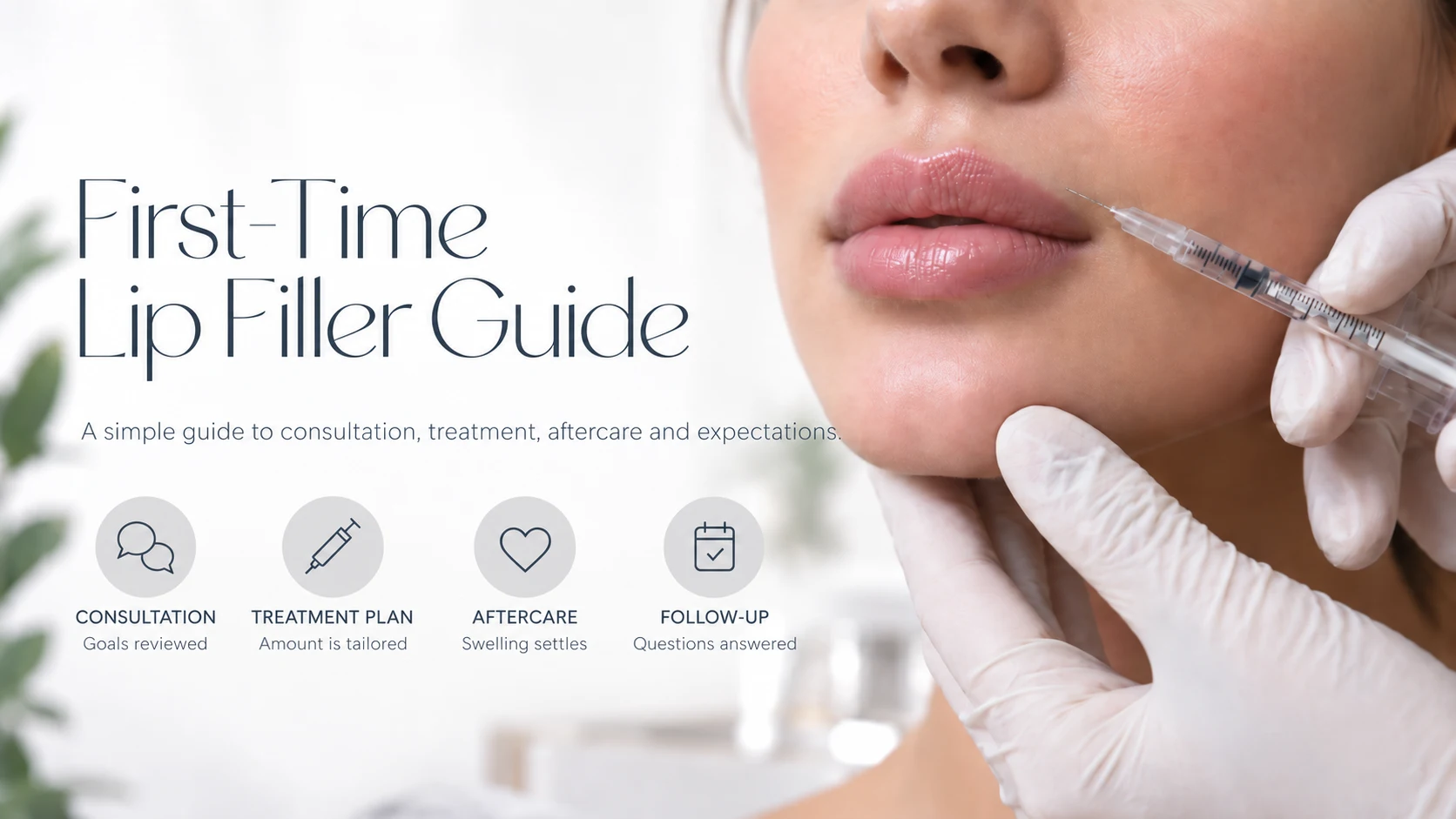
Getting lip fillers for the first time can bring up practical questions. How much filler will you need? Will it hurt? What will your lips look like straight afterwards? And how do you explain the result you want?
You do not need to arrive at your appointment knowing the answers or having already chosen an amount of filler. Your first consultation should help establish what you want to change, assess your natural lip anatomy and review your medical history before treatment is planned.
Knowing what to expect before, during and immediately after your first appointment can help you approach treatment with more realistic expectations.
Think about the change you want to see rather than deciding how many milliliters of filler you think you need.
Before your consultation, consider what you would like to change about your lips.
You may want:
It is equally useful to explain what you do not want. For example, you may want to retain your existing lip shape or avoid excessive projection.
You do not need to use medical or aesthetic terminology. Explaining what you notice about your lips and how subtle or noticeable you want the change to be gives your doctor useful information when planning treatment.
Your first consultation should establish your goals, assess your lips and review your medical history before a treatment plan is recommended.
Your doctor will assess your lips in relation to your overall facial proportions. Your existing lip shape, volume, symmetry and upper-to-lower lip balance can all influence what may be appropriate.
Your consultation may cover:
This is also the time to ask what can realistically be achieved with your natural anatomy.
The treatment plan should follow this assessment rather than being based solely on a filler amount requested before your appointment.
There is no standard amount of lip filler that every first-time patient needs.
The amount recommended can depend on:
More filler does not automatically create a better result. Choosing the smallest amount available does not automatically mean it will be appropriate either.
The doctor should recommend the amount after assessing your lips and understanding the result you want.
0.5 ml and 1 ml describe the volume of filler being used; they do not tell you exactly how your lips will look afterwards.
Someone with naturally fuller lips who wants more definition may need a different amount and placement from someone looking for a more noticeable increase in volume.
Your lip anatomy, existing volume and treatment goal all affect how a particular amount appears.
Instead of choosing between 0.5 ml and 1 ml before your consultation, explain the change you want and allow your doctor to recommend an appropriate amount.
Reference photos can help explain your preferences, but another person’s lips cannot be reproduced exactly on your face.
Photos are most useful when you explain what you like about them. For example:
Natural lip anatomy, facial proportions and existing volume differ between people.
Use reference images to communicate your preferences rather than expecting an identical lip shape.
Prepare by giving your medical team accurate information and following the pre-treatment instructions provided to you.
Before treatment:
Some medicines and supplements can affect bleeding or bruising. Do not stop prescribed medication yourself because you have booked lip fillers. Any medication changes should be discussed with the healthcare professional responsible for prescribing them.
An active cold sore, infection or inflammation around the treatment area may also affect whether treatment should proceed that day.
Allow enough time before an important event for temporary swelling or bruising to settle.
Cleveland Clinic recommends scheduling lip filler at least two weeks before an important event such as a wedding.
This is particularly useful for your first treatment because you do not yet know how your own lips will respond to injections.
Avoid booking your first appointment immediately before a wedding, vacations, photoshoot or another occasion where temporary swelling or bruising would concern you.
Once you and your doctor agree on the treatment plan, your lips are prepared, the filler is placed and the result is checked before your aftercare is explained.
Your appointment may include:
The treatment is not simply about injecting a predetermined number of milliliters. Placement and quantity need to work together with your natural lip anatomy.
You may feel pinching, pressure or stinging during lip filler injections because the lips are a sensitive area. The level of discomfort varies from person to person.
Depending on the product and treatment approach, topical anesthetic may be used, while some filler formulations contain lidocaine. Mild discomfort or a pinching sensation can occur during lip filler injections.
Inform your doctor if you are particularly concerned about needles or discomfort so they can explain what to expect before treatment begins.
Your lips may look fuller than expected immediately after treatment because the early appearance includes temporary swelling as well as the filler itself.
You may notice:
One side can also swell more than the other. This means the lips you see immediately after injections do not necessarily represent your settled result.
Swelling, redness, bruising, pain and tenderness are recognized reactions following dermal filler injections.
Wait until the early swelling has settled before assessing the final volume, shape and symmetry of your lips. Your first result is better understood in stages.
Immediately after treatment: Your lips may already look fuller, but swelling can exaggerate the change.
During the early settling period: Swelling and bruising can temporarily affect shape and symmetry.
As your lips settle: The filler placement and overall lip balance become easier to assess.
At follow-up: Your medical team can review how your lips have settled and discuss any concerns.
Avoid deciding that you need more filler while early swelling is still affecting what you see.
The doctor will explain the aftercare that applies to your treatment before you leave the clinic.
Your instructions may cover:
Aftercare recommendations can vary according to your treatment and individual circumstances.
Follow the instructions provided by the medical professional who treated you rather than applying a generic online aftercare routine to yourself.
Before leaving, you should know what was used, what to expect next and who to contact if you have a concern.
Make sure you understand:
Knowing the filler product and amount used also gives you a useful treatment record if you consider lip filler again in the future.
A follow-up may be recommended to assess your lips after the early post-treatment changes have settled. It does not automatically mean you need more filler.
A follow-up can be used to review:
Whether further filler is appropriate should be based on your settled result and treatment goals rather than treating a “touch-up” as an automatic next step.
Contact your treating medical professional if you develop unexpected symptoms or your recovery is not progressing as you were advised it should.
Temporary swelling, bruising, redness and tenderness can occur after dermal filler injections. Serious complications are much less common, but some require prompt medical attention.
For a detailed explanation of expected reactions, complications and warning signs, read our Lip Filler Risks, Side Effects & Contraindications guide.
Before your first treatment in Dubai, check who will assess and treat you, where the procedure will take place and what follow-up is available afterward.
Dubai Health Authority’s current Standards for Non-Surgical Cosmetic Procedures, Version 2.1 have been effective since 18 February 2025. The standards require healthcare professionals to work within their approved scope of practice and emphasize patient information, appropriate assessment and collaborative decision-making.
Before your first appointment, make sure you understand:
DHA has also reminded licensed healthcare facilities and professionals that cosmetic procedures must only be performed by appropriately licensed professionals within their authorized scope of practice.
At Maris Aesthetic Clinic, first-time lip filler treatment begins with medical assessment and discussion of your goals before a treatment plan is agreed. Maris Clinic has operated with DHA approvals since 2017, providing injectable treatments within its regulated clinical setting.
Your first lip filler appointment should begin with a discussion about your goals, natural lip anatomy and medical history rather than a fixed amount of filler chosen in advance.
Knowing what to expect before, during and immediately after treatment can help you approach your first appointment with realistic expectations.
If you are considering lip fillers in Dubai, schedule a consultation with our medical team to discuss your goals, suitability and the treatment approach that may be appropriate for you.
Book a personalized consultation with our medical team and discover the treatments tailored to your skin and lifestyle.