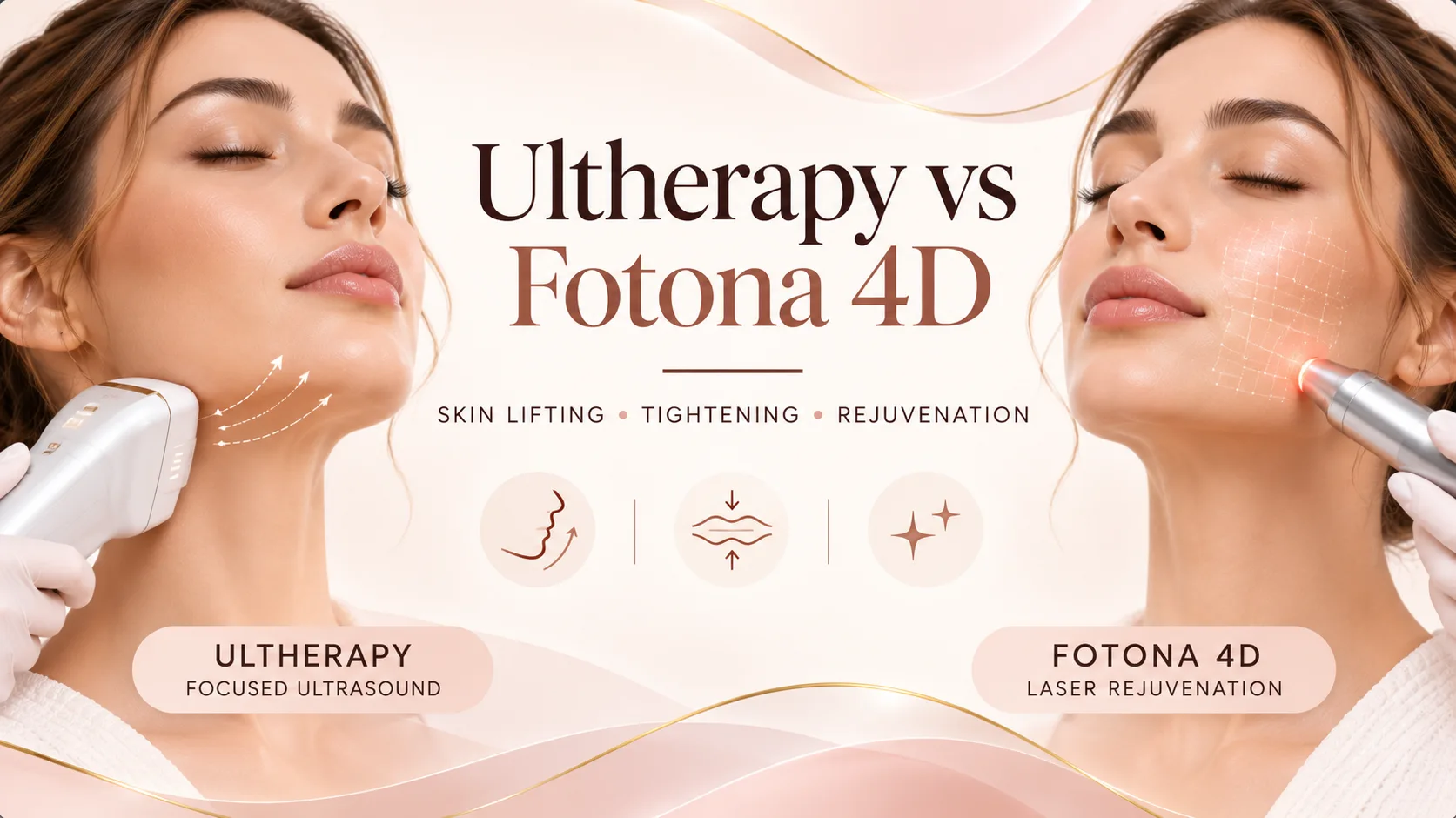
Ultherapy and Fotona 4D are non-surgical skin tightening treatments that use different technologies to improve facial firmness and signs of aging. Ultherapy uses focused ultrasound energy to target tissue at selected depths and support lifting, while Fotona 4D combines laser treatments to improve skin tightness, fine lines and texture.
Both treatments stimulate collagen remodeling, but in different ways, different areas treated and different expected results.Ultherapy is primarily for lifting of the skin, while Fotona 4D is a more holistic facial rejuvenation treatment that also assists with refinement on the surface level.
We offer both treatments at Maris Clinic in Dubai, and evaluate individual skin concerns before discussing appropriate options. This guide compares how Ultherapy and Fotona 4D work, their results, discomfort, downtime and the factors that can influence your treatment decision.
The main difference is that Ultherapy uses microfocused ultrasound for targeted skin lifting, while Fotona 4D uses two laser wavelengths across four treatment stages for tightening and skin rejuvenation.
Ultherapy delivers ultrasound energy beneath the skin without resurfacing its surface. Fotona 4D combines intraoral tightening, laser-induced collagen remodelling and a light superficial peel.
| Feature | Ultherapy | Fotona 4D |
|---|---|---|
| Technology | Microfocused ultrasound with visualisation | Er and Nd lasers |
| Primary focus | Skin lifting and tightening | Skin tightening and facial rejuvenation |
| Treatment depth | Selected dermal and deeper tissue depths | Multiple layers, from oral mucosa to skin surface |
| Common concerns | Loose skin beneath the chin, neck laxity and brow drooping | Early laxity, fine lines, folds and uneven texture |
| Collagen stimulation | Yes | Yes |
| Skin resurfacing | No | Includes a light laser peel |
| Sessions | Often one initial treatment | Commonly a series of sessions |
| Results | Develop gradually over several months | Surface changes and gradual collagen-related improvement |
| Downtime | Usually minimal | Usually limited; depends on laser settings |
| Treatment suitability | Based on anatomy and degree of laxity | Based on skin firmness, texture, tone and sensitivity |
Neither treatment is automatically more effective. The most appropriate option depends on whether your main concern is loose skin, surface texture or a combination of both.
Both treatments use controlled energy to create a response in the skin that encourages collagen remodelling. However, the technologies deliver energy differently and do not produce identical effects.
Ultherapy treatment uses microfocused ultrasound with visualisation (MFU-V) to deliver energy at selected depths beneath the skin.
The ultrasound energy creates small, controlled areas of heat within the targeted tissues. This stimulates a healing response associated with collagen remodelling and gradual skin tightening.
Ultherapy also uses real-time ultrasound imaging, allowing the practitioner to visualize tissue layers and select appropriate treatment depths. The technology is used for concerns such as brow drooping, laxity beneath the chin and loose neck skin. It can also improve lines and wrinkles on the décolletage.
Because Ultherapy does not resurface the outer skin, the treatment is primarily focused on lifting and tightening rather than correcting superficial texture or pigmentation.
Fotona 4D laser treatment combines two laser wavelengths, Er (2940 nm) and Nd (1064 nm), in a four-step facial rejuvenation protocol. Each stage has a different purpose:
SmoothLiftin: An intraoral Er treatment applied inside the mouth to stimulate collagen remodelling around the cheeks and mouth.
FRAC3: Uses Nd laser energy to target selected age-related skin imperfections and encourage rejuvenation.
PIANO: Delivers controlled heating to support tightening across the treated skin tissues.
SupErficial: Uses a light Er laser peel to improve superficial texture and skin appearance.
Targets skin firmness and surface quality when combined. This makes Fotona 4D different from treatments that focus primarily on deeper tissue tightening. Fotona also offers other laser protocols, so the effects and recovery associated with Fotona 4D should not be assumed to apply to every Fotona treatment.
Ultherapy is primarily suited to selected skin-lifting concerns, while Fotona 4D may be considered when skin laxity occurs alongside fine lines, folds or uneven texture.
The main differences become clearer when comparing individual concerns.
| Skin concern | Ultherapy | Fotona 4D |
|---|---|---|
| Mild to moderate skin laxity | May improve lifting and firmness | May improve firmness and tightening |
| Loose skin beneath the chin | Established treatment application | May offer tightening in selected patients |
| Sagging jawline | May help where lower-face laxity contributes | May improve skin firmness and contour appearance |
| Drooping brows | FDA-cleared application | Not a direct equivalent to Ultherapy brow lifting |
| Fine lines | May improve some wrinkles | Addresses fine lines through laser rejuvenation |
| Uneven skin texture | Not its primary purpose | Includes superficial texture refinement |
| Nasolabial folds | Limited effect where volume loss is the main cause | May soften their appearance through collagen-related changes |
| Significant facial volume loss | Does not replace lost volume | Does not directly replace lost volume |
The distinction between skin laxity and facial volume loss is important. Loose skin may respond to an appropriate tightening procedure, whereas hollow cheeks or deep folds caused by volume loss may require a different treatment approach.
Similarly, neither Ultherapy nor Fotona 4D is a substitute for surgical lifting when substantial excess skin is present.
Ultherapy may be more appropriate when targeted lifting is the main objective, while Fotona 4D may be considered when improving both skin firmness and surface quality is the priority.
Ultherapy delivers focused energy into selected tissue depths without treating the outer skin. Its principal treatment goals include lifting the brow and tightening lax tissue beneath the chin and around the neck.
Fotona 4D combines tightening with superficial skin rejuvenation. Its four-stage approach can address concerns such as fine lines, uneven texture and early loss of firmness. However, treating more tissue layers does not automatically mean Fotona 4D produces a stronger lifting result.
In a systematic review and meta-analysis looking at microfocused ultrasound with visualization, 42 studies were assessed and it was found that some patients had some degree of esthetic improvement. The findings also highlighted differences between study methods and the need for further high-quality research.
Clinical studies have also assessed laser-based facial tightening, such as the Fotona protocols. However, the evidence available does not show that Fotona 4D is better than Ultherapy or vise versa for all facial concerns. The degree of skin laxity, treatment area and individual anatomy remain important factors in determining realistic results.
Ultherapy often begins with one treatment session, while Fotona 4D is commonly performed as a series. Both treatments produce changes over time, and maintenance needs vary.
Ultherapy results usually develop gradually as collagen remodelling occurs over the following months.
Some patients notice early changes, but more visible improvements commonly develop around two to three months after treatment. Further changes may continue beyond this period.
One initial session is often sufficient for an assessment of response, although additional or maintenance treatments may be considered. Results can persist for a year or longer in some patients, but natural aging continues and the duration varies.
Fotona 4D may produce earlier improvements in skin texture and appearance, while tightening develops progressively through collagen remodelling.
Depending on the protocol of the type of treatment and the individual concerns of your skin, a course of several treatments, spaced a few weeks apart, is usually recommended.
Improvements may develop over weeks to months. Maintenance depends on the initial response, skin condition and treatment objectives. Neither method permanently stops the aging of the skin. Sun exposure, skin health, age and individual biological responses can influence how long results remain visible.
Both Ultherapy and Fotona 4D generally involve limited downtime, but the sensations during treatment and temporary skin reactions differ. Ultherapy can produce noticeable warmth, tingling or deeper discomfort as ultrasound energy reaches the targeted tissues.
Fotona 4D may cause warming, mild snapping sensations or temporary surface sensitivity. The SupErficial laser stage can also produce redness or light peeling, depending on the treatment settings.
| Recovery factor | Ultherapy | Fotona 4D |
|---|---|---|
| During treatment | Heat, tingling or deeper discomfort | Warming, laser pulses or surface sensitivity |
| Common immediate effects | Redness, tenderness or mild swelling | Redness, warmth or mild swelling |
| Skin peeling | Not expected | Possible after the superficial peel |
| Return to daily activities | Often the same day | Often quickly, depending on protocol |
| Aftercare | Follow instructions for treated areas | Sun protection and appropriate skin care are particularly important |
Individual comfort varies. Ultherapy is not necessarily more painful for every patient, and Fotona 4D should not be described as completely painless. Your practitioner may discuss comfort measures and aftercare based on the treatment area and planned energy settings.
Both treatments can be considered across a range of skin tones, but suitability and safety depend on the patient’s skin condition, treatment settings and medical history.
Ultherapy uses ultrasound rather than light energy, so its mechanism does not depend on targeting skin pigment. This can be relevant for patients concerned about laser-related pigmentation changes.
Fotona 4D uses laser energy and includes a superficial resurfacing stage. Laser settings, treatment intensity, recent tanning and individual pigmentation tendencies must therefore be considered carefully.
Patients with darker skin tones or a history of melasma and post-inflammatory hyperpigmentation may require additional assessment before laser treatment. Possible adverse effects include:
Ultherapy: Temporary redness, swelling, tenderness, bruising, tingling or numbness. Less common complications, including nerve-related effects and unwanted tissue changes, have been reported.
Fotona 4D: Temporary redness, warmth, swelling, sensitivity or peeling. Burns, blistering and pigmentation changes are possible, particularly when treatment parameters or aftercare are unsuitable.
Eligibility may be affected by active skin infections, certain implanted medical devices, pregnancy and other medical considerations, depending on treatment and device guidance. The Ultherapy manufacturer’s safety instructions outline contraindications, precautions and potential adverse effects.
At Maris Clinic we will assess your skin type, treatment history and areas of concern before discussing suitability. This is particularly important for patients with pigmentation concerns, previous energy-based treatments or existing facial fillers.
The choice depends primarily on the concern you want to improve, the extent of skin laxity and whether skin surface quality also requires treatment. Ultherapy may be considered when:
Your main concern is loose skin beneath the chin or around the neck.
You want to explore non-surgical brow lifting.
Targeted lifting is more important than surface resurfacing.
You prefer a treatment that often begins with one session.
Fotona 4D may be considered when:
You have early skin laxity alongside fine lines.
Uneven skin texture is part of your concern.
You want to explore laser-based facial rejuvenation.
You are comfortable with a course of treatment sessions.
These considerations help explain the differences but do not replace a clinical assessment. At Maris Clinic, we look at the degree and location of skin laxity, skin texture, facial structure and your expected improvement before discussing treatment options.
For example, concerns concentrated around the brow or beneath the chin may lead to a different recommendation from concerns involving early facial laxity and rough skin texture. We also consider whether non-surgical tightening is likely to produce a meaningful improvement or whether another approach may be more appropriate.
Ultherapy and Fotona 4D are two different methods for rejuvenating the face without surgery. Understanding their mechanisms, benefits and limitations can help you identify which treatment may better match your skin concerns.
At Maris Clinic in Dubai, we offer both technologies and focus on assessing what your skin needs rather than recommending a treatment based on its popularity alone.
During your consultation, we take into account skin laxity, texture, treatment history, medical suitability and your desired results.We can then talk about the expected results, number of sessions and after care for each option.
Book a consultation at Maris Clinic to explore Ultherapy and Fotona 4D and understand which treatment may be appropriate for your facial rejuvenation goals.
Ultherapy is a specific microfocused ultrasound treatment with real-time visualisation. HIFU is a broader term used for focused ultrasound technologies. Devices differ in their imaging capabilities, energy delivery, indications and clinical evidence.
Neither is universally better for jowls. Ultherapy may help when skin laxity contributes to lower-face sagging, while Fotona 4D may improve firmness. Significant jowling or volume loss may require a different approach.
Ultherapy does not rely on absorption of light by skin pigment.Fotona 4D may be used with appropriate settings but the risks of laser-induced pigmentation should be carefully assessed, particularly in darker or recently tanned skin.
Both treatments may be considered within a broader rejuvenation plan when they address different concerns. Combining them is not automatically necessary. Treatment sequence, timing and suitability require clinical assessment.
No. Both treatments can provide non-surgical improvements in selected patients, but neither removes substantial excess skin or reliably reproduces the lifting achievable through surgery. Results are generally more modest.
Fotona 4D may soften the appearance of certain folds through tissue tightening and collagen remodelling. However, it does not directly replace significant lost facial volume in the same way as appropriately placed dermal fillers.
Book a personalized consultation with our medical team and discover the treatments tailored to your skin and lifestyle.